Monday, December 12, 2016

It's A Wonderful Life -- Or Is It?

I'll bet a good many of us will find time between now and the end of the year to watch at least a couple of the "holiday classics" such as It's A Wonderful Life.   But how many of us will take the time to reflect on what that movie says to us in today's terms.

The problem with the movie is that there are so many important messages that it's hard to know where to start.  Having faith, never giving up, being generous instead of greedy and not always focusing on material things for happiness are the obvious starters.  Those are mostly individual things, of course, but are there important lessons for us collectively?  I think so.

Jardin du Soliel Lavender Farm, Washington
Canon EOS 7D, 24-105mm

Just for starters let's examine the benefit to society of a strong middle class.  Because the Bailey Building and Loan made it possible for average working people in the community to afford quality housing they prospered.  The money spent and saved helped others in the community to also enjoy a positive, middle-class lifestyle.  Although Mr. Potter is viewed as the villain that he is he is a villain because of greed.  

Profit is not a dirty word.  Businesses must make a profit to survive and for employees and survivors to flourish as well.  But in today's business world profits are not only required but must be maximized which often means that the "one percent" does well but not many others.  This may not be so troublesome in very good times but when those times are up it's feast or famine.

While we feel warm fuzzies over It's A Wonderful Life I suspect we overlook the post-Depression recognition that the key to a healthy economy and society is a strong middle class.  When Main Street and Elm Street prosper Wall Street should prosper, too.  But today too much emphasis is placed on Wall Street and the phrase "everything in moderation" is usually assigned to caloric intake.


Mount Saint Helen's, Washington
Canon EOS 7D, 24-105mm
Where our political and economic policies fail us is that they don't emphasize the value of a strong middle class which sustains both the rich and the indigent.  The postwar economic boom proved this.  So did FDR's New Deal.  Putting people to work improving our infrastructure brought the nation out of economic crisis and taught us -- or at least should have taught us -- that paychecks are better than welfare checks.

Supporting a strong and growing middle class isn't a handout or charity.  It's an investment that produces substantial returns.

Making A Good Point Without Rubbing It In Your Face

Bison, Yellowstone National Park
Canon 40D, 500mm 1.4x


CBS did the nation a favor Sunday night -- showing two colorized episodes of The Dick Van Dyke Show.  Most of us have either forgotten or never knew what it was like to have a television program make a point in troubled times without being graphic, tacky or beating you over the head.

Rewind to 1963, one year before the Civil Rights Act of 1964 became law.  The cutting edge comedy show then was Dick Van Dyke's in which the iconic actor and a newbie named Mary Tyler Moore played Rob and Laura Petrie, suburban white dwellers in suburban New Rochelle.  Rob was a writer for a fictional comedy show starring Carl Reiner.  Laura was a suburban housewife who while young and attractive had a mind of her own.

In this particular episode Rob was recalling coming home from the hospital with Laura and newborn son Richie.  The show starts off with Rob being weighted down by all the gifts and paperwork to bring home from the hospital, some of which was meant for another couple.  This was in good humor until Rob begins freaking out over the possibility that maybe the hospital goofed and sent them home someone else's son.

Slapstick turns to paranoia as Rob increasingly adopts a marginally plausible theory of how this could have happened culminating in a telephone conversation with the other dad, a Mr. Peters who also lives in New Rochelle.  Rob begins to lay out his mixup theory and Mr. Peters says that he's nearby and will be there in a few minutes.

The doorbell rings.  Moments later Rob and Laura and welcoming Mr. and Mrs. Peters, a well-dressed affluent young black couple, into their home.  The conflict is, of course, immediately resolved but our lesson doesn't stop there.  Mr. Peters tells Rob that he didn't disclose the dispositive truth over the phone because he wanted to see Rob's reaction.  They do the 1963 equivalent of a fist bump and amicably part ways.  There's more.

The program ends with Rob telling his friends that Richie and the Peters boy are classmates and while Richie isn't the brightest student in the school the Peters boy aces everything.

Wow  In the space of a minute or two we've had a bushel of bricks dumped on us and never felt any pain.  The anxiety was felt by Reiner and the writers because CBS didn't want to go there but they convinced the network that if the studio audience liked it the scene would stay in.  The audience did.

53 years ago we didn't see blacks being treated as equals on television and here we have not only a couple that rival the Petries but also the black husband got the last laugh.  Actually, two because we also had a black child attending a suburban school where he's the head of the class.  There were no lectures, graphic videos, guilt trips, intimidation ploys or whatever.  Just some ingenious writing with a message that could be just as viable today.

Ah, but now there would have to be something ugly, salacious, indecent or profane for television to pay it attention.  They would have to rub our noses in it.  Some people would find it offensive enough to tune it out or else dissociate because they cannot relate.  Our consciences wouldn't be so engaged.  Nor our minds.

It isn't always easy to get people to think -- or do -- the right thing,  But it's easier when they feel good about thinking and/or doing it.


Friday, December 2, 2016

Come back to the Smokies

Foothills Sunrise, Great Smoky Mountains National Park
Canon EOS 1D Mark II, 70-200mm

It's hard for any of us with a connection to "the Smokies" to not feel a sense of pain, loss and grief over the horrendous wildfires which so far have claimed at least 13 lives and destroyed 1,000 or more homes and buildings in the Gatlinburg and Pigeon Forge area.  The destruction is wide and deep.  Many people literally escaped with the clothes on their back.  It is a tragedy so enormous that it's hard to fully grasp.

But in the depths of this tragedy there is resilience and perseverance.  You see it in the firefighters who have refused to go home and rest, instead catching a few hours of sleep on the pavement so that they can continue to try to save what can be saved.  You see it in the people who have already committed to rebuilding their homes and businesses.  You see it in the folks who are helping each other, including Dolly Parton's offer of $1,000 a month for up to six months for people who've lost their homes and belongings.

Mountain folk are like that.  Strong.  Resilient.  They've known hardships and have persevered.  They will likely bury the dead, heal the injured and persevere.  God bless them in this.  But they can't do it alone.  They need us.

Obviously they need us to help support the organizations bringing relief to those affected by the fires. They need us to stay away while the rescue personnel are doing their jobs so we don't get in the way.  But then they need us to come back.  

The Great Smoky Mountains National Park remains intact.  So does the core of downtown Gatlinburg.  Dollywood is reopening.  Townsend escaped the wildfires.  The worst thing we can do for ourselves and for the people of the area is to be reluctant to come back.  The mountains are still there.  They will call us in the spring to see the renewal of life.  There will still be deer shedding their winter coats in Cades Cove.  The dogwood will bloom again along the rivers and streams.  And even at some point the "touristy tacky" parts of Gatlinburg and Pigeon Forge will again compete with Wisconsin Dells for the crown of "ugliest city in America."

Tourism -- that's us -- is the economic engine of the Smokies.  When it's safe to return, we should. Getting life back to normal as quickly as possible will be the greatest help in healing those who are hurting.  They need us.  So come spring let's make it a point to come back.  Yes, it may be a little difficult at times to avoid focusing on what was destroyed but then we should -- and must -- turn our attention to what remains and what is is being renewed as it always has been and will be.  Have faith and all will go well.

Little River, Great Smoky Mountains National Park
Canon 40D, 24-105mm


Sunday, November 6, 2016

Endangered Species: Camera stores

Tunnel View at Daybreak, Yosemite National Park, California
Fujifilm X-T2 XF 18-55mm

Camera stores were funky places.  Most of them were run by photographers who parlayed their love into a business.  Some were good business people, some not.  Others were run by people who knew little about cameras -- a couple I know of actually had sales people wearing shirts and ties which, except for shooting a wedding or some formal event is grossly overdressed.  Some were large stores with huge inventories, others mom-and-pop places and there were a lot in between.  One thing in common is that they are rapidly dying off and we are not the better for it.

I must be up front and say that some of these stores were there own worst enemies -- arrogant, overpriced, misleading -- but others simply fell victim to changing economic times and often an inability to keep up with them.  Kenosha is down to one store, Rode's, which has limited hours and limited stock.  Racine's Camera World store closed years ago.  Calumet Photo in Chicago and nationwide is gone.  So is Shutan and Helix is down to one store with a smaller stock.  There were four or five camera stores in Monterey, California recently but now it's down to two and one is no longer open weekends or downtown.  Sam's Camera in Kalispell, Montana is gone along with two other competitors.  Jackson, Wyoming had three or four stores a few years ago.  Only one is left.

The most recent casualty seems to be Keeble and Shuchat in Palo Alto, California, recently shuttered after 51 years in business.  This was a full-line store (actually two stores, one across the streets from the other with one featuring used gear) in a college town (Stanford) that isn't Podunk.  The owner was quoted as giving several reasons why business is down -- online competition, discount stores like Costco and high sales tax rates.  I found out about this today when I drove there to buy some accessories and the doors were closed and the shelves bare.


Montara State Beach, California at sunset
Fujifilm X-T2, XF 18-55mm

Local camera stores are important places.  They don't just sell cameras, they sell knowledge and camaraderie.  I remember well walking into The Camera Company in Madison 37 years ago and walking out with what I needed to start a darkroom.  They also sold me cameras, lenses, strobes and a lot of chemicals.  They had competition, too, now all gone.

The strange thing is that people are taking lots of photos these days but are using iPhones instead of Nikons and printing is done at Walgreens or on your own printer, not by Kodak or a local lab.  People are buying cameras at Amazon, Costco, Sam's Club and what's left of Ritz Camera (which wasn't much of a real camera store, anyway).  The funny thing is that all you get from these places is a box with a price tag that's sometimes even higher than a local store's.

I buy my camera bodies at local stores.  My two main cameras now were purchased at National Camera Exchange in Minnesota and Vistek in Toronto.  The pricing was as good or better and the service was much better.  I've purchased camera bodies and lenses from many other stores, most all too happy to ship them to be.  Because of what's called MAP (minimum advertised pricing) F-11 in Bozeman, Montana could sell me a Canon camera body for the same price as B&H in New York or Amazon.  The bonus is when I am shooting in Yellowstone and need something photography related F-11 is there for me.  Same with Pro Photo Supply in Portland when I am in the Pacific Northwest.  And I've bought camera and lenses from stores in Spokane, Peoria, Dallas, Kalamazoo, Indianapolis and even B&H, Adorama and Berger Brothers in New York which are also local stores.

If you buy a camera at Best Buy you're probably being overcharged and, even if not, you are anyway because you don't get the knowledge and personal service that you would at most local camera stores.    If you don't shop local stores they will simply keep dying off and then, guess what?  Higher prices and poorer service due to less competition.

So, let me make this plug for you to do as much business as you can at a local camera store.  We need to keep them alive and their business flowing.

Bridal Veil Falls on a windy day, Yosemite National Park, California
Fujifilm X-T2, XF 18-55mm

Saturday, March 26, 2016

Seeing Beauty

Tunnel View after sunset, Yosemite National Park, California
Fujifilm X-E2, 18-55mm
Have you ever had difficulty seeing the beauty in something that didn't quite look or seem terribly good at first impression?  I have  --  more often than I'd like to admit.

Earlier this month when I was in Yosemite National Park I had some unusually good photo opportunities but they came at the expense of capturing some of the "usual" ones.  Sunset at Tunnel View was not to be for me that evening.  

Instead of leaving I stood around and looked for what I may not have seen at first glance.  The warmth of sunset vanished and was replaced by cool, flat light.  I gave the scene a few more looks and decided that I would try to capture it in black and white.  I think it was a good choice not to abandon it without giving it another change.

Isn't it that way with other things in our lives?  

Recently I had a woman in front of me in court who returned to the apartment from which she had been evicted to retrieve the personal property that the movers left behind.  A deputy sheriff who oversaw the eviction told her not to come back and testified that the movers put everything of obvious value in storage.  A neighbor saw the woman go back into the apartment and called the police.

Sounds like a clear case of trespassing, right?  

There's more to the story.  The defendant was homeless and a chronically mentally ill single mother with two children who isn't getting any child support from their father.  The things left behind in the apartment were of value to her and she went back inside to get them,  And despite the strikes against her she has her illness under reasonable control and works at a low-wage job to support her children.

Clearly she was trespassing and I found her guilty which was to her undoubtedly yet another "failure" in her life.  Before imposing sentence I asked her to tell me about herself and anything else she thought I should know.  She threw in the towel and had nothing much to say.  So I asked her to tell me something good about herself because I was sure she was pretty used to hearing about all the not so good things.  Slowly we talked about her work, her challenges and her children.  

I could have viewed this woman as a lawbreaker caught once again.  But I wanted to take another look.  Was the glass half full or half empty?  Yes, she was wrong but if you put yourself in her shoes, what would you have done?  Obviously she was doing about all she can to keep it together and support her children, a tough task for most people with limited income but even rougher when you're chronically mentally ill.  

I fined her $100 -- less than the prosecutor wanted but actually pretty stiff when you consider that it's about half of her weekly take home pay. 

Sometimes taking another look at something turns out that you see it differently than you did at first.

Monday, March 7, 2016

Horsetail Falls


Horsetail Falls, Yosemite National Park
Fujifilm X-E1, 55-200mm
Fishermen often talk about "the one that got away" and for me Horsetail Falls in Yosemite National Park was like that for many years.  I was in Yosemite ostensibly at "the right time" but Mother Nature didn't get the memo.

Until last week.

Horsetail Falls is really misting water falling downward that during parts of February can become passionately illuminated just before and at sunset.  It doesn't always happen but when it does it's a special occasion -- one, I might add, that's shared by hundreds of people who often have waited for hours for "the right shot."

Despite being a "captive audience" it's not a glum one.  Families picnic, sometimes inviting their temporary "neighbors" to share food and drink.  Photographers offer up their stories and tips for getting a good shot.  Park rangers who once were persnickety about where people parked finally came up with a better idea: temporarily close one of the two lanes on the one-way westbound road so that people could park there.  It's kind of like a football game where people are tailgating together, happy with a victory and sad for a loss but happy for the company along the way.

There are, of course, parallels to life here.  If you want something, showing up is half the battle and sticking with it the rest.  You might not always succeed on the first try -- or maybe the second or third.  But eventually patience and perseverance is likely to win out.  If you get discouraged and give up you'll never succeed.  And even if you didn't get "the shot" you've had the fellowship of kindred spirits.   Life is good.

Horsetail Falls at sunset, Yosemite National Park
Fujifilm X-E1, 55-200mm


Note:  It doesn't take a lot of equipment to shoot this but the right gear on hand is critical.  A lens with a 200-300mm effective range, a circular polarizer, a remote shutter release and your camera mounted on a tripod will help you zoom in and maintain sharpness.


Wednesday, November 18, 2015

Want good photographs? Get up early, be there for the best, stay with it, be on watch for unexpected magic and don't give up when others have gone home.

Zion National Park, Utah
Fujifilm X-E2, 18-55mm


There is a privilege to seeing God's glory as a nature photographer.  The mystical light before and just after sunrise and an hour before up to and sometimes after sunset.  The privilege to the non-photographer may seem somehow glamorous and exclusive but it really isn't.  It's a matter of being there for the best light and, in the rest of the day, being on watch.

Many times I arrive at an airport around midnight and drive to a photo location, arriving in the cold darkness and waiting for the chance to see if there will be color in the sky as the sun is getting ready for its day.  Yes, it would be nice to sleep in but often when I do I miss the best of the best.

The photo above at Zion National Park shows pre-sunrise light illuminating the peaks.  Seeing it is pure excitement because it's a good harbinger of what's likely to come if you're there -- and patient.

A few minutes later you can see the color beginning to pop yet still make out detail in the shadows.
 Zion National Park, Utah
Fujifilm XE-2, 18-55mm

The light will dance around for a couple of minutes more, enticing you with a bit more color before the shadows become darker and the reddish glow turns into bright sunlight and harsh shadows.  Some people will see that blue sky and call it a "picture perfect day" but it really isn't.  The sun is basically good for two things.  Sunrise:
Bryce Canyon National Park, Utah
Fujifilm XE-1, 55-200mm

And sunset:


Bryce Canyon National Park, Utah
Fujifilm X-E1, 55-200mm
In a short time the glorious light of early day is gone.  The rest of the day is pretty bland, photographically speaking and often there isn't much to do in between.  But sometimes God has a way of interrupting PNT (photographer nap time) because an overcast, stormy day can also produce scenes you ordinarily won't find during that "picture perfect day."

Upper North Falls, Silver Falls State Park, Oregon
Fujifilm X-E1, 55-200mm


In the middle of the afternoon rain and fog began rolling in.  The waterfall wasn't even visible but after a 20-minute standoff the fog blew off ever so softly.  Most of the time the waterfall wouldn't be photogenic at that time of day -- harsh light and bright white "hotspots."  And when the sun goes down it doesn't automatically mean packing it in.  There was still a little magic left in this shot at Bryce Canyon:

Paria View, Bryce Canyon National Park, Utah
Fujifilm X-E1, 55-200 mm

Photography doesn't just record life -- it often mirrors it.  I've heard it said that half of the battle in life is just showing up.  (Photographers used to call that "f/8 and be there.")  If you're not there you may miss the best light -- and the best in life.  And instead of running off when the good light burns off it's always a good idea to be on watch just in case something unexpected pops up.  Even at the end of the day when the sun has relaxed its ultraviolet grip on us there can still be magic if you're patient and, more important, there.

“Therefore keep watch, because you do not know the day or the hour."  Matthew 25:13.  The temptation to give up is often there.  Maybe the day is going to suck anyway, so why bother?  What if it isn't?  What if you're not there?  Well, when the good light is gone, it's gone.  If I am not there the opportunity is lost.  There is no rewind button.  No pause button, either.  And the next day might be a total bust.  As for mid-day magic, it's not likely to happen but it does on occasion and when that happens you want to be on watch, ready for the moment.  Stick with it.  Be ready.  

Oh yes, for He causes His sun to rise on the evil and the good, and sends rain on the righteous and the unrighteous.  Matthew 5:45.  But the best experiences will likely fall on those who show up early, remain on watch, stay in the game and don't give up when others want to go home.  And getting outside of your comfort zone counts, too, whether it's in photography or in life.


Saturday, October 10, 2015

Can we -- no, we must -- TALK!

Pronghorn antelope, Yellowstone National Park North Entrance, Gardiner, MT
Canon EOS 7D, 500mm f/4L 1.4x


Another murder.  Another mass shooting.  Another wacko killing innocent people.  And the same old, same old response which is more like a non-response.  One "side" will gasp and say we must do something about gun control while another "side" recoils at even the suggestion.  Of course, nothing gets done and the same story will play out again -- and again.

As sad and disturbing as this example is it clearly illustrates what's wrong with our political and social environment today:  our minds are like concrete -- all mixed up and permanently set -- and we  simply don't and won't talk.  Worse, many of us will simply (or rudely) dismiss anyone who doesn't agree with us, devaluing them as well as their ideas.  Truly we may well have met the enemy and he is us.

With respect to gun violence another problem is that both "sides" are ostensibly "right."  Connecticut has strict gun laws but that didn't protect those innocent children at Sandy Hook.  Conversely all those gun totin' Arizonans did squat to help Gabby Giffords.  There may be some truth somewhere in between those extremes but I sure don't know where it is and I doubt anyone else does, either.

But that doesn't mean we should give up searching for that truth even if we may never find it.  And we should not give up respect for each other in the process.  

Folks who favor more firearms restrictions must realize that "When guns are outlawed only outlaws will have guns" isn't entire a simplistic dismissal.  Making, selling and possessing heroin is illegal but it hasn't stopped the epidemic of heroin deaths.  As the Dixie Chicks ("Goodbye Earl") reminded us passing a law is no guarantee that it will be obeyed ("He walked right through that restraining order and put her in intensive care").  

On the flip side that doesn't mean we should abandon all hope.  The nation's highways are dramatically safer after tougher drunken driving laws and a shift in public attitude toward impaired driving.  While many people are still killed and maimed by drunken drivers the number is less than it once was thanks to tighter laws passed with public support.  So, no, we can't stop all tragic episodes with firearms but maybe we can agree that some additional restrictions could at least prevent a few of them.  Maybe we could agree that it makes little sense that we have background checks and waiting periods when you buy a gun from a licensed dealer but none of that applies when buying from a private party.  Maybe we could agree that you should do a little more than take a class and send in $50 and some box tops to get a concealed carry permit.  Maybe we could agree that we need to look a little more carefully at prospective gun buyers to determine if we have an undiscovered "nut job" waiting to explode -- and maybe we need to make sure better records are kept so that they have less of a chance of falling through the cracks.

Maybe, just maybe, we can talk this out, realizing that no law is an insurance policy against tragedy but having no laws is also just as impotent.  And maybe we can can the hostile, simplistic rhetoric long enough to engage in this dialogue.  Together, we are stronger.

The journey of a thousand miles begins with a single step.  Who has the will to take it?

Lewis Falls, Yellowstone National Park, Wyoming
Fujifilm X-E1, 55-200mm

Thursday, September 24, 2015

Pope Francis: What would Jesus do?

Mount Moran at Oxbow Bend, Grand Teton National Park, Wyoming
Fuji X-E1, 55-200mm, circular polarizer
America has "Pope fever."

Pope Francis -- the "people's pope -- is doing his level best to set his church, other churches and politicians across the world on fire with simple messages designed to hit home, not some etheral place where the messages will be neatly filed and ignored.

But what the pope is doing isn't really rocket science.  It's about bringing is back to where we should have been before religion got in the way of faith.

Pope Francis is definitely pro-life but he has called for outreach to and forgiveness of women who have had abortions.  He supports traditional marriage but refuses to judge gays.  He wants churches to be hospitals for sinners, bloody from being in the streets working with the poor and underprivileged.  Francis shuns excess and blasts those who embrace it while calling us to be good stewards of the earth and its resources.

None of this is really particularly radical theology.  It's pastoral.  It's real. It reaches the gut level.  It's the epitome of "what would Jesus do?"

Perhaps that's why Pope Francis is so popular.  He's walking the walk.  And he wants us to join him.  He's telling pastors to stop sending letters to the Corinthians and instead tell it like it is to the people at home.  And while some Catholics comfortable with orthodoxy are reluctant to embrace him Pope Francis is a rock-star for many non-Catholics and even non-Christians.

Why?

Maybe it's because he is filling a need we are so hungry for -- spiritual guidance plus encouragement that we who are not perfect people are nonetheless loved and capable of good.  Maybe it's because of the shallow emptiness of our political, business and social leaders.  Maybe, just maybe, it's because he's doing what Jesus would do if he was here today -- consort with, encourage and forgive sinners and the marginalized.  For non-Catholics -- for whom Francis calls their leaders "brother bishops" -- it's a sign of what they wish their churches would be.

Sunday, June 28, 2015

Oak Creek Police Lt. Brian Murphy demonstrates that's he's a hero in more than one way

Wooden Shoe Tulip Farm, Oregon
Canon EOS 7D, 24-105mm, ISO 200, 1/50 sec/ @ f/8

Guest commentary published today in the Milwaukee Journal-Sentinel

When I heard the news of the mass shooting in a historic African-American church in Charleston, I was overcome with grief and flooded with memories.

Three years ago, I was the police officer who arrived on the scene of a mass shooting in a Sikh gurdwara [temple] in Oak Creek. The gunman Wade Michael Page had just murdered six people, wounding many more, when I engaged him. Page shot me 15 times before turning the gun on himself.

Ever since that moment, I have thought about what makes people like Page and Dylann Roof carry out deadly acts. Both are white supremacists. Both committed heinous acts in houses of worship at a time when people had gathered in community and prayer. Both killed people based on the color of their skin.

It would be easy to shrug off any responsibility in what they did. But I believe that people who were near both of them must have witnessed their spiral into hate and violence. Someone must have seen and known, deep inside, that there was trouble ahead. Why didn't they stop them? As someone who has looked hate in the eye — and survived — I believe that we each have a role in changing the culture that produced Roof and Page.

It begins with calling out racism in our own homes and communities. We tend to overlook things that bother us, the racist slur or sign of bigotry. We try not to get involved with situations outside our comfort zone. We want to be treated fairly and justly and, yet, we deny that treatment to people we see as different. But the costs are too great to stay silent. In this moment, we must have the courage to reach out to our neighbors, because we desperately need to understand each other.

We can start by learning from the families who survive these mass shootings. The families' response to the horrific violence in Charleston is profoundly similar to the Sikh community's response in Oak Creek. Both did something that speaks volumes about who they are: They forgave. They forgave those who trespassed against us, men who killed in the most coldblooded way. They looked these killers in the face and prayed for them. Forgiveness does not mean that we forget. Forgiveness frees us from hate, so that we can change our hearts and lives.

Now is the time for each of us to forgive. We must forgive our own ignorance and the way we harbor stereotypes and prejudice. We must forgive ourselves so that we can become braver and better. Only then can we change how we treat the people in our lives.

Some suggest that the massacres in Oak Creek and Charleston reveal that no matter how we try, we cannot reach everyone. For me, acts of hate make the job of reaching people that much more urgent and necessary. People at their foundation are good. There is no one completely out of reach; we just have to try harder. By Roof's admission, he almost didn't carry out his evil plan because the people were so nice to him.

We can start with how we treat the person next to us. The simplest act of kindness and compassion can change a person's life. Start now, this very second. Be the person you always dreamed of being. Be a beacon of hope to our children. Let them know we are better than the actions of a few people who have denied themselves the ability to see one another as brothers and sisters. Let us emulate the behavior that God has asked of us. Let us welcome, respect, and love one another.

This is the best way to honor the lives lost in Charleston and Oak Creek. If we don't change the culture of this country, starting with our own hearts, we are doomed to repeat the past.


Lt. Brian Murphy was wounded in the line of duty when arriving on the scene of the shooting at the Sikh Temple of Oak Creek on Aug. 5, 2012.

Wednesday, June 24, 2015

What I Learned From Flying

Snake River at Oxbow Bend
Grand Teton National Park, WY
Canon EOS 7D, ISO 200, f/16 @ 20 sec.

My photography and faith buddy, Bill Fortney (http://www.billfortney.com), blogs incessantly about the connection between his faith and photographic pursuits.  One of those pursuits was his outstanding book America From 500 Feet which is a collection of images Bill took while flying an ultralight aircraft.  

Not sure I have what it takes to fly an ultralight but I have taken the stick of a Cessna 172 and a Dehavilland Beaver and an now beyond a Delta "Million Miler" frequent flyer.  But I've learned many life lessons from flying. 

I don't have time for the crap that holds me down.   My first flight in a Cessna 172 was from the Rice Lake Municipal Airport.  My instructor, Jim Maslowski, briefed me on all the things I needed to do but as soon as the propeller began spinning my head began spinning.  As the plane proceeded down the runway I was filled with dozens of crippling anxieties -- one of those "whole life flashing in front of you moments" -- of all the possible things that could go wrong superimposed on my own perceived inadequacies.  

The the truth hit me: this turkey has to get up in the sky or else we're going down in the lake.  Simple as that.  There isn't time to worry about all that crap.  Suddenly that which anchored me down instantly disappeared and the Cessna began its journey to Eau Claire.  

Cheapest and most effective therapy in the world.  Unless you want to wind up in the bottom of the lake, there isn't time to worry about all the crap that will keep you from soaring.

Delta isn't going to hold the plane for me if I get to the airport late.  It's been said that half of the key to success in life is just showing up.  I think you also have to be there on time or you just might miss out.

There are times in life when caution is appropriate if not indeed life-saving.  There are charlatans in our midst who would seek to pressure us to make hasty decisions that benefit them, not us.  And there is no guarantee against making a bad decision.  Obviously, to paraphrase the old Merrill Lynch saying, it's a good idea to investigate before you invest.

But indecision can also become a decision.  If you wait until the last minute to get to the airport and arrive late you're probably going to miss the plane.  The airline isn't going to hold it for you and doesn't care why you weren't there to board on time. You blew it and there's probably nobody else to blame.  Life doesn't always operate on my schedule.

Now we can get angry at the airline, the traffic, the airport and life in general but no matter what Delta isn't holding the plane.  We have no right to expect that they will.  Remember the parable of the three servants?  Did it ever seem odd that the one who was outcast was the one who didn't use the resources the master gave him?

Honesty is still the best policy.  There are many times when things don't work as I had planned. Maybe traffic was bad and I didn't get to the airport on time.  Sometimes there have been emergencies at home and I need to get back.  Sometimes I got busy and lost track of time.  

The best answer to "what to do" in those situations is simply to tell the truth.  No, Delta isn't going to hold the flight for me but there are times when it came to my rescue after I told the truth, even whey they weren't obligated to do so.  In fact, I never asked for emergency waivers if there wasn't one and I never had a "doable' request turned down.

Bad things still happen to good people.  As much as Delta has helped me in times of crisis they've also dumped on me, too.  Funny that as a customer Delta tells me all the wonderful things they're doing to "enhance" my experience bur as a stockholder the same executives talk with glee about how they're able to screw customers to maximize profits.  And the number of times I and other customers have been "enhanced" continues to grow.

There is no guarantee life will be fair, even if you are.  See the preceding paragraph.

When something doesn't go your way it may not be the worst thing.  I had an out-of-town meeting to make and was less than pleased that my flight to Chicago was cancelled due to fog and poor weather conditions.  I wound up driving to Madison. The airplane that was supposed to have been the connecting flight collided with another aircraft and ten people on the plane I would have been on were killed.  Sometimes be thankful for blessings in disguise.  See below as well.

When one door closes, another may open.  So many times I have been angry and hurt that something didn't happen as I wanted -- whether it be a job, a relationship, an investment or even a photo opportunity.  The first problem is that it was what I wanted.  Maybe God had a different idea and often the replacement plan was a better deal (although it rarely seems like it at the time).

I had a crappy fall shoot at Yellowstone and the Tetons.  The elk rut was disappointing (although the trumpeter swans were out), I got fewer shots in the Tetons than I had hoped for, the moose and pronghorn antelope were hiding from me and I was heading back with little to show for my time there.  Needless to say I was pretty disappointed (to say the least).

But as the sun had set and I was heading north out of the Tetons I turned to the left and saw the silhouette of a man fishing against the colorful sky.  I slammed on the brakes, jumped out, grabbed a camera and tripod and yelled at the man asking if he would please stay still for a few seconds.  He complied with my request and the result you can see below.


Snake River at Sunset
Grand Teton National Park, WY
Canon EOS 7D, ISO 250, f/8 @ 2 sec.


Friday, June 19, 2015

Charleston: It is better to light one candle than to curse the darkness

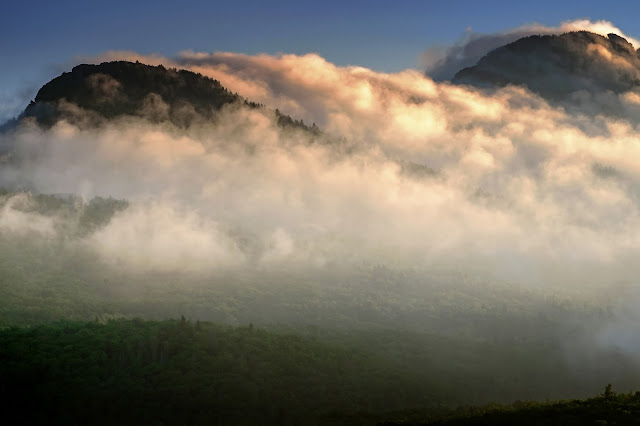
Grandfather Mountain, North Carolina
Fujifilm X-E1, 55-200mm @ 157mm, 1/13 sec. @ f/16, ISO 200


The intolerable atrocity in Charleston, South Carolina has predictably resulted in more useless speeches, calls for legislation, finger-pointing and race-baiting as people struggle to comprehend this act of terrorism in a house of worship by a deranged young man full of hate.  Some say -- and the evidence suggests -- that he is a racist but on balance that's way too simplistic, way too convenient and way too incomplete of an explanation with no realistic answers.

This young villain is, unfortunately, neither unique or simple.  We've seen his ilk before.  We know that terrorists and bullies rely on shock and intimidation to bolster their cause, whatever it is.  And in typical responses we are often sucked into this tornado of hate.  But it doesn't have to be that way.

This tragedy has many analytical challenges.  We know this perpetrator is a racist.  But one can be a racist without being violent.  We know he's likely mentally imbalanced.  But there are many mentally ill people who are not dangerous.  We know that he singled out black victims, which suggests racism and a hate crime, but then it is carried out in a church, which implicates an additional level of deranged hate.

I am going to resist -- and I encourage you to do the same -- the temptation to offer knee-jerk reactions or solutions.  If we want to overcome this then we will need to work at it and I surely don't have all the answers.  But I do know that we've seen this before and we'll likely see it again and thus it calls to mind the old proverb that it's better to light one candle than to curse the darkness.  In spite of prejudice, instability and hate there can be good triumphing evil and it can be ordinary people who rise to the occasion.  These are not platitudes but real world experiences that happened not far from us -- things that brought out both the worst and best of people.

Stuart, Iowa -- a small town of maybe 1700 people -- is a little west of Des Moines off Interstate 80 and just down the road from where I was a police officer nearly 40 years ago.  Stuart was the home of All Saints Catholic Church, an ornate and beautiful "cathedral on the plains" built by skilled immigrants in 1908.  It was an impressive work of art in a most unusual place -- the type of edifice normally found in some major cities.

All Saints was a house of worship, of course, and the center of the area's Catholic community for 87 years.  But the worst came on August 22, 1995.

A man consumed with deep rage for the Catholic church poured gallons of gasoline throughout All Saints, igniting an inferno that required the efforts of more than 20 fire departments from a 50-mile radius to suppress.  The beautiful copper dome was gone.  Police had to shoot out stained glass windows in order for firefighters to get their hoses in position.  

The arsonist, who boldly bragged of his deed, was arrested, tried and convicted, serving 13 years in prison before he was paroled.

The architects and insurance company said it was too costly to rebuilt All Saints, so the parish took the insurance check and built a nondescript new building on the end of town.  The insurance company, Diocese of Des Moines and parish council may have walked away from the old All Saints but the people of little Stuart, Iowa did not.

For whatever reasons -- maybe Iowa stubbornness had something to do with it -- it just didn't seem right to let someone get away with torching a church.  It didn't matter if you were Catholic, it still wasn't right.  Walking away from the old All Saints was tantamount to letting a terrorist win.  The people of Stuart didn't want that to happen.

Another team of architects went through old All Saints.  Despite the massive damage done to the church's interior, windows and dome somehow miraculously the shell of the 1908 structure remained sound and, ironically, the fire actually strengthened the steel beams in the walls. Consequently the repair estimate was revised dramatically downward.

It took years to raise the $4 million to complete the project but donations, grants and $1.7 million approved by the voters in this town of 1700 saw the Saints Center for Culture and the Arts open its doors in 2009.  Not only is the old All Saints a community center but it houses a museum devoted to religious tolerance.  

“We wanted to show that in the end, tolerance is much stronger than hate,” said Liz Gilman, who headed the museum project.

Probably most folks have never heard of Stuart, Iowa or it's just a dot on the map.  But the people of Stuart taught the world a lesson or two.  Tolerance is much stronger than hate.  And we're not going to let a terrorist destroy a house of worship.

History teaches us that the predictable reactions in the days, weeks and months following the despicable hate crime in Charleston will likely generate more heat than light, more anger than love, more problems than solutions.  We need to tune out these unproductive messages and instead turn to the people of Stuart who showed us not only that it is better to light one candle than to curse the darkness -- but also that it can be done by ordinary people who rise to the occasion.

The Emmanuel AME church in Charleston wasn't torched but it was nonetheless desecrated by a hate crime that left nine of its people dead.  It won't take years of fundraising to rebuild but rather perhaps the nation's churches could demonstrate that tolerance is much stronger than hate by delivering this message at home and staging pilgrimages to Charleston to stand in solidarity with the people of Emmanuel AME church.


Thursday, June 18, 2015

Back To My (Photographic) Roots

Mount Hood at Trillium Lake, Oregon
Fujifilm X-E2, ISO 200, 18-55mm @ 29mm, f/16 @ .6 sec

I started in photography -- fourth grade, to be exact -- shooting black and white film in a $20 Sears camera that was so advanced it had "electric eye."  Color film and processing were very expensive at the time, especially for a kid.

Later when I moved to a series of more advanced cameras I continued to shoot black and white film because it was (1) cheaper, (2) I could process and print it myself and (3) it was considered the film of the artist.   The learning curve was fun, especially watching prints come to life in the tray under the safelight.  Photoshop wasn't around then so most adjustments had to be made up front.

But the 1990's began a new era where people saw things in color and learning color photography was a new, steeper learning curve -- especially with digital imaging.  Dynamic color was expected.  Pretty much been the same thing ever since.  Mostly.

I am probably a Pacific Northwest guy by heart.  Some of my favorite photography hotspots are there, including Mount Hood which is about 90 minutes, give or take, southwest of Portland.  On a good day when the wind is light, the sky is colorful and clouds cooperating the photography can be exhilarating.  But on a lackluster day…meh.

My last trip to Trillium Lake to photograph Mount Hood started out with promise but turned more or less to lackluster.  The "mojo" just wasn't there.  What would Ansel Adams have done?

I'm not sure I can accurately guess the answer but most of his work was in stunning black and white.  So I pretended I was shooting with a red filter, sharp polarizers and was printing on Agfa Brovira Speed and what was "meh" turned into "it wasn't such a bad day, after all."

Life is like that, too.  Sometimes we start out along a path we think is correct but things don't work out as planned and it turns to a "meh" day.   That's when I think it's helpful to consider whether it's possible to turn a lemon into lemonade.

Does that always work?  Nope.  But sometimes it's worth a shot.

Pun intentional.


Wednesday, June 17, 2015

Back to Blackwater Falls

Blackwater Falls, West Virginia, May 16, 2015
Fujifilm X-E2, 18-55mm @ 27mm, 1/2 sec. @ f/16, ISO 200
In March I made the three-hour-or-so drive from Washington, D.C. to Blackwater Falls which is located in the West Virginia state park of the same name.  I was disappointed that dangerously icy conditions made it impossible to make it to the lower viewing platforms.  Even more disapponting: the lodge was closed for repairs which meant no trip to the restaurant for its buffet breakfast.  

Returning last month the lodge was open as was the 200+ steps to get to the lower platform.  There aren't a lot of shot possibilities in the park but those that exist are worthwhile.  Ditto for the breakfast.

Another good time for a visit is in October where there may be fall color.  West Virginia has a great state park system -- free admission -- with lodges in some parks.  Nearby Canaan Valley is often a great fall color spot in October and a ski destination in winter.  And there's also a buffet breakfast!


Saturday, June 13, 2015

Where -- and what -- is your church?

Sunrise, Foothills Parkway, Great Smoky Mountains National Park, TN
Fujifilm X-E1, 55-200mm @ 148mm, ISO 200, 1 sec. @ f/16


Pope Francis has a lot to say about what the Church -- big "C" -- and the little "c" as well -- ought to be.  "I prefer a church which is bruised, hurting and dirty because it has been out on the streets, rather than a church which is unhealthy from being confined and from clinging to its own security," he wrote. "I do not want a church concerned with being at the center and then ends up by being caught up in a web of obsessions and procedures."  

He added: "More than by fear of going astray, my hope is that we will be moved by the fear of remaining shut up within structures which give us a false sense of security, within rules which make us harsh judges, within habits which make us feel safe, while at our door people are starving and Jesus does not tire of saying to us, 'Give them something to eat.'"

I was moved a lot by this and by his call for churches to be hospitals for sinners as opposed to museums for saints.  This, of course, is nothing terribly new.  In the early 19th century the Danish philosopher and theologian Soren Kierkegaard wrote: "The church bells call to prayer, but not in a temple made by human hands. If the birds do not need to be reminded to praise God, then ought men not be moved to prayer outside of the church, in the true house of God, where heaven's arch forms the ceiling of the church, where the roar of the storm and the light breezes take the place of the organ's bass and treble, where the singing of the birds make up the congregational hymns of praise, where echo does not repeat the pastor's voice as in the arch of the stone church, but where everything resolves itself in an endless antiphony."


Bryce Canyon National Park, Utah
Fujifilm X-E2, ISO 200, 50mm, 6/10 sec. @ f/16

And so I struggle with my own church -- the small "c" -- which is embarking on a capital campaign to "finish" the worship space which is not carpeted and parishioners sat in chairs until the recent addition of hand-me-down pews and kneelers, a throwback to the "Good Old Plastic Jesus" days.  How do I reconcile this with what the pope is calling for these days -- a church that is frugal, humble and out in the streets?

My parish held its first Mass nearly 17 years ago in a school cafeteria which we quickly outgrew. We then went into the gym for a few years until the banks let us build a worship center which had high ceilings, huge doors and a big debt in a troubled economy without the money to "finish" the project.

But despite the financial stress in the ensuing years there was something special about the "unfinished" church because it did, in fact, symbolize that building the church was a work in progress.  Our faith didn't need high ceilings or pews or kneelers.  We were a church active in the community, reaching out in social ministry despite our own troubles.  The church wasn't a building but rather the people.

Somehow that began to fade a bit and now there is a focus on "finishing" the worship space.  This doesn't seem to square well with what Pope Francis is telling us to be.  Yes, we need a "base camp" for our ministries which is what I would add to the papal call for us to be a hospital for sinners.  But that's what our churches should be -- hospitals and base camps, not monuments,  We are expected to get (at least figuratively) bruised and bloody in the streets, not comfortable inside.

It's a delicate balance.  I always liked the idea of the "unfinished" project as a symbol that our mission is a work in progress, reinforced by our simple chairs and concrete floors.  We were a community of faith and a beacon of hope when we were in the cafeteria.  The building doesn't make the church, the people do.  And the presence of God is not necessarily confined to a structure of stone, concrete and steel beams.  It can be experienced in the solemnity or simplicity of outdoors and in the grace of His people.

Monday, June 8, 2015

Patience: A Virtue I Wish I Had More Of

Photography is often an instruction manual for life skills.  Patience is one of them.  Sometimes I wish I had more of it.

Much of the time photographers must react quickly because of logistics.  The shot might not be there if you wait or safety or weather concerns narrow the window of safe opportunity.
Blackwater Falls, West Virginia
Fufifilm X-E2,, ISO 200, 16-55mm @ 34mm, 10 sec. @ f/16

This winter shot of Blackwater Falls was a quick study because of weather and safety conditions.  Icy conditions left only a portion of the trail open thus restricting the view.  So I had to make the best of what I was handed at the moment.

Sometimes, though, waiting and having faith that there will be a better opportunity is the best course of action.  Such was the case this winter when I waited for a sunset opportunity at Montara Beach at Half Moon Bay south of San Francisco.

Pacific Ocean at Montara Beach, California
Fujifilm X-E1, ISO 200, 55-200mm @ 86mm, f/16 @ 5 sec.


I wasn't sure if it was possible to come back with a good image given the conditions and the logistics but, again, I tried to make the best of the situation.  This was also true in April when I was searching for a good sunset opportunity in the Seattle area which isn't always an easy task.

I wound up south of the airport at the waterfront not far from Anthony's Restaurant in Des Moines, Washington.  The area was crowded but as the sun was going down few people remained.  Those who did were rewarded for their patience.

Puget Sound, Des Moines, Washington
Fujifilm X-E1, ISO 200, 55-200mm@ 172mm, f/16 @ 2.5 sec.

I am often one of the least patient people in the world.  But there are times when I have to wait and have faith that the wait will be worth it.  It usually is.


Mike Royko's Finest Column: A Love Story

Minnehaha Falls
Minneapolis, MN
Fuji X-E1, 55-200mm, f/16 .7 sec


The late Mike Royko wrote this column to his readers more than two weeks after his first wife, Carol, died suddenly of a brain hemorrhage. The Chicago Sun-Times published the column on Oct. 5, 1979. 

It helps very much to have friends, including so many whom I've never met. 

Many of you have written to me, offering words of comfort, saying you want to help share the grief in the loss of my wife, Carol. 

I can't even try to tell you how moved I've been, and I wish I could take your hands and thank each of you personally. 

Others have called to ask when I'll be coming back to work. I don't know when. It's not the kind of job that should be done without full enthusiasm and energy. And I regret that I don't have much of either right now. 

So I'm going to take a little more time off. There are practical matters I have to take care of. I want to spend time with my sons. And I can use some hours just to think and remember. 

Some friends have told me that the less I look to the past the better. Maybe. But I just don't know how to close my mind's door on 25 years. That was our next anniversary, November. 

Actually, it was much longer than that. We met when she was 6 and I was 9. Same neighborhood street. Same grammar school. So if you ever have a 9-year-old son who says he is in love, don't laugh at him. It can happen. 

People who saw her picture in this paper have told me how beautiful she appeared to be. Yes, she was. As a young man I puffed up with pride when we went out somewhere and heads turned, as they always did. 

But later, when heads were still turning, I took more pride in her inner beauty. If there was a shy person at a gathering, that's whom she'd be talking to, and soon that person would be bubbling. If people felt clumsy, homely and not worth much, she made them feel good about themselves. If someone was old and felt alone, she made them feel loved and needed. None of it was put on. That was the way she was. 

I could go on, but it's too personal. And I'm afraid that it hurts. Simply put, she was the best person I ever knew. And while the phrase "his better half" is a cliche, with us it was a truth. 

Anyway, I'll be back. And soon, I hope, because I miss you, too, my friends. In the meantime, do her and me a favor. If there's someone you love but haven't said so in a while, say it now. Always, always, say it now.  

Friday, February 20, 2015

Lighten up!

It was almost eight years ago that I took a nasty fall on ice in Alaska. I made it home but was in a ton of pain for weeks.  It took a while to get back into the swing of things but I started with, out of necessity, carrying less equipment and getting back to basics.

Courthouse Falls, North Carolina
Canon EOS 1D II, 24-105mm @ 47mm, ISO 250, f/11 at 2.5sec

Funny thing.  When I lightened up I had more fun.  I didn't shoot quite as many images as I had in the past but for some reason I got some arguably decent shots and had fun in the process.

Roaring Fork, Great Smoky Mountains National Park, TN
Canon EOS 20D, 24-105mm @ 32mm, ISO200, f/16 @ 1 sec.

Carrying less of a load was more than just being less painful.  It freed me up to concentrate on what's important and I saw an improvement in my images.  So, if you want better outcomes and less pain, maybe -- just maybe -- the trick is to lighten up.